Projects
Selected projects. Full list of papers on the publications page.
A protein interactome for the last eukaryotic common ancestor
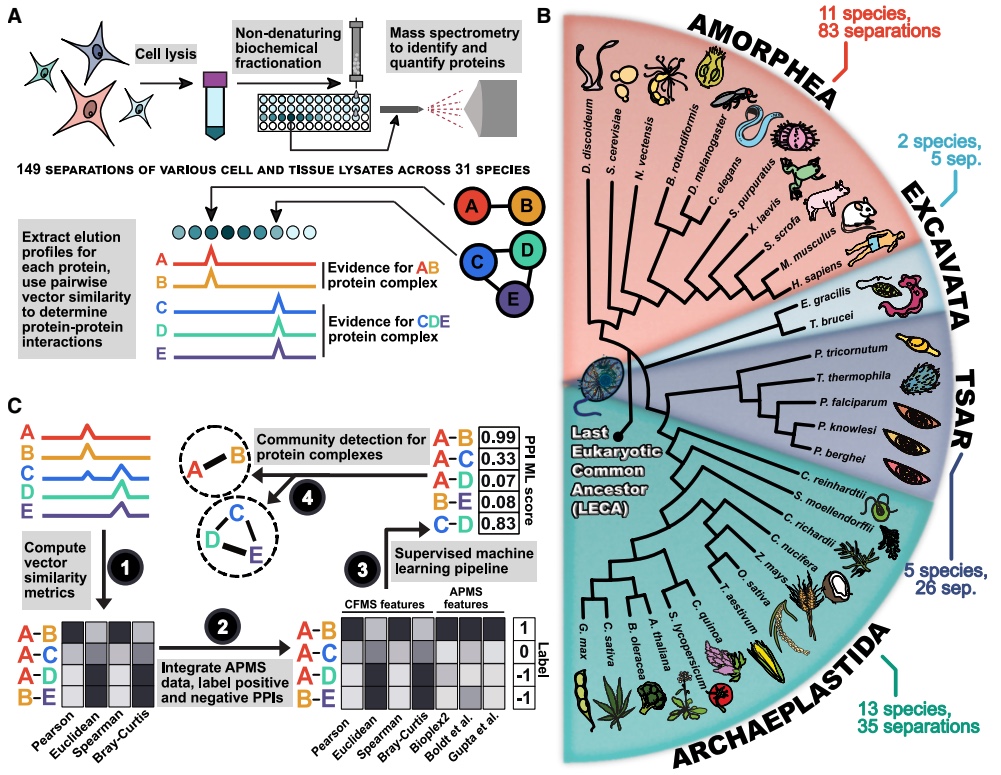
Every eukaryote alive today — you, a frog, a dandelion, a budding yeast — descends from a single cell that lived 1.5 to 1.8 billion years ago. Roughly half the gene families we still carry were already present in that ancestor, and a quarter of them have never been characterized. I wanted to know what those ancient proteins were doing, and whether the answer could tell us anything useful about human disease.
I compared genes across 156 organisms to define the gene families most likely present in that common ancestor, then built a machine learning pipeline over more than 26,000 mass spectrometry experiments from 31 species to infer which of those ancient proteins physically assemble into complexes. The result is a reconstructed interactome: a biochemical snapshot of how the first eukaryotic cell was organized, containing both the machinery we already knew about and assemblies nobody had described.
Because these complexes are conserved across a billion years of evolution, a poorly understood human protein can be annotated via guilt-by-association with its ancient neighbors. We used the network to predict new human gene–disease associations for bone density and congenital birth defects, then validated those predictions in frogs and mice with collaborators at Boston Children's Hospital.
- 156organisms compared
- 26,000+proteomics experiments
- 31species integrated
Built with Co-fractionation mass spectrometry · proteomics · phylogenetics · machine learning · Python · R · bash · HPC